Showing posts with label Personal Literary Essay. Show all posts

Monday, March 19, 2018

Finding What She Wants in "What I Want"


What I Want

What do I want?
Well… besides such and such.
Just someone to spend eternity with, that’s all.
Is that to ask too much?

Imagine, if you will, a small pudgy white boy alone in a small house, on a small island in the middle of the Pacific Ocean. I was serving a mission for my church in the small island Kingdom of Tonga. My companion, or as I called him my com-pain-ion, was asleep in the other room suffering from puke faka-ngaue (the sickness that conveniently overtakes a person when work is to be done). Like all of the other young men I was paired up with, I was assigned to work with him. He was a local kid who had very little work ethic and liked his sleep.

Once Upon a Snowy Night


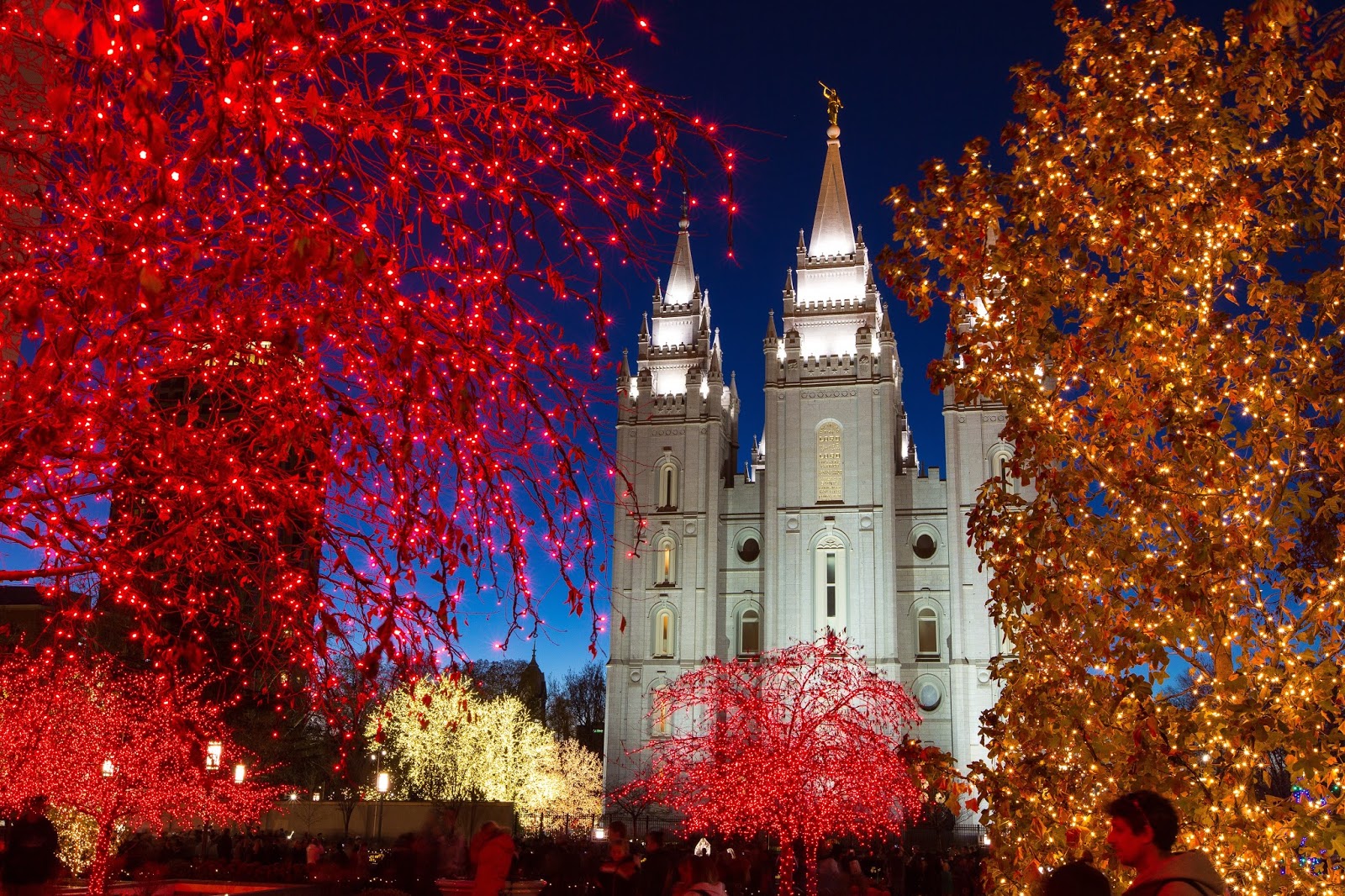
It is a few days from Christmas. Snow drifts lazily down in the cold air as a little girl is hoisted onto her father's shoulders. She is surrounded by softly glowing lights, scattered in the bare trees. A knit hat falls over her eyes and her laughter mingles with that of her father. A white castle rises in the distance, crowned with a golden angel. A sweet melody, drifts throughout the square as if sung by unseen heavenly hosts:

The Spirit of God like a fire is burning!
The latter-day glory begins to come forth;
The visions and blessings of old are returning,
And angels are coming to visit the earth.

We’ll sing and we’ll shout with the armies of heaven,
Hosanna, hosanna to God and the Lamb!
Let glory to them in the highest be given,
Henceforth and forever, Amen and amen!

"The Spirit of God" by William W. Phelps is a beloved hymn within the Church of Jesus Christ of Latter-day Saints (more commonly known as Mormons). It is a song of triumph and joy which looks forward to the Second Coming of Jesus Christ. It is often sung around Christmastime. Every time that I hear or sing this song, I am brought back to that night in temple square. The lyrics to that song have long been one of my favorites, even when I was too young to fully appreciate their meaning. The sweet feeling that accompanies the music always makes me warm, no matter now cold it may be outside. 

Sunday, March 18, 2018

Can I Just Have a Sick Day?

As a child, some of my fondest memories I have are snuggling up in my nice warm bed on a cold, snowy, drab day and listening to my mom read me the "funny stories" from the "book that had silly drawings". Little did I know, Shel Silverstein was providing a type of solace for me then and now.  I pretty much had those short little poems memorized, and I probably still do. Looking back to those care-free days where all I really had to worry about was being able to spell my own name, I remember the poem that I always loved my mom to read and I found it to be the most entertaining. Perhaps I enjoyed it so much because I could relate to it fairly well.

Not so Flowery Poetry

In the year 2015 I was introduced to what would become one of my favorite podcasts of all time. Set in a small desert community Welcome to Night Vale is the story of a weird little town where strange is the norm and all that is too be expected is that you can never really predict what will happen next.

When my cousin first explained to me about the show and how it was a series of broadcasts from a community radio station in a fictional town I thought it was strange, and it is. But from the first episode I was hooked, the stories were goofy and engaging and host Cecil Baldwin has a wonderful way of presenting and expressing himself. Needless to say I have been listening ever since and I love it. In addition to giving updates on the town and residence of Night Vale however the show often has sections of poetry and music as well. On February 19 2015 the episode Poetry Week was released, creators Joseph Fink and Jeffery Cranor invited listeners to submit their own works of poetry for a chance to be read on the show. Just recently I was rereading some of my favorites when I stumbled across this particular piece that was submitted by a fan and while it was never aired on the show I fell in love with it. The short piece is entitled Nympholepsy and reads as follows;


There once  was a time when man
claimed the jungle as his garden
... and paradise died

So man reconstructed a new garden
out of concrete and steel
... and earth wept

In this man-made garden
there was little room for flora and fauna
brother turned against brother
and sister turned upon sister
The garden stank of death and hate
... and earth wept

within this diseased and dying concrete jungle
balance became unbalanced
man's garden became rife with nympholepsy
Soon callousness and greed became the paean of humanity

And the descent from grace became a nuclear race
to defile yet even another garden


Saturday, March 17, 2018

Making Friends with Pablo Neruda


Poetry had always been an assignment rather than an art form. I did not connect well with poetry; whether it was due to the fact that I did not understand it or simply because I was forced to read it, I will never know. I flew through my public education experience with an apathetic approach to poetry and thought I would never have to encounter it again, let alone connect with it. My life drastically changed when directly after high school I chose to serve as a missionary for the church of Jesus Christ of Latter-day Saints.

Monday, March 12, 2018

Can I Just Have a Sick Day?


As a child, some of my fondest memories I have are snuggling up in bed on a cold night and listening to my mom read me the "funny stories" by Shel Silverstein. I pretty much had those short poems memorized. Looking back to those care-free days, I remember the poem that I always loved my mom to read and thought it was the most funny. Perhaps I liked it so much because I could relate to it...

“I cannot go to school today,"
Said little Peggy Ann McKay.
“I have the measles and the mumps,
A gash, a rash and purple bumps.
My mouth is wet, my throat is dry,
I’m going blind in my right eye.
My tonsils are as big as rocks,
I’ve counted sixteen chicken pox
And there’s one more—that’s seventeen
And don’t you think my face looks green?
My leg is cut—my eyes are blue—
It might be instamatic flu.
I cough and sneeze and gasp and choke
I’m sure that my left leg is broke—
My hip hurts when I move my chin,
My belly button’s caving in,
My back is wrenched, my ankle’s sprained,
My ‘pendix pains each time it rains
My nose is cold, my toes are numb
I have a sliver in my thumb.
My neck is stiff, my voice is weak,
I hardly whisper when I speak.
My tongue is filling up my mouth,
I think my hair is falling out.
My elbow’s bent, my spine ain’t straight,
My temperature is one-o-eight.
My brain is shrunk, I cannot hear,
There is a hole inside my ear.
I have a hangnail, and my heart is—what?
What’s that? What’s that you say?
You say today is. . .Saturday?
G’bye, I’m going out to play!”

I can remember my mom and I laughing as we acted out the poem. Eventually the two of us had it memorized by heart.


Part of the reason I think this poem was particularly easy for me to memorize was because of the rhyming words that Shel Silverstein uses. The rhyme scheme in this poem help it to flow and roll off the tongue easily. Another reason I was able to memorize this poem so quickly was also because I could and still can totally relate to Peggy Ann McKay. Shel Silverstein did an incredible job of describing exactly what a young child would say/do to not have to go to school.

Silverstein does a great job demonstrating the use of imagery in his poem.

"A gash, a rash, and purple bumps".

This particular line of the poem is just one example of imagery. As the reader, I can physically see a gash, a rash, and I can even imagine purple bumps. "Purple bumps" is terminology a young child would most definitely use to try and get out of going to school.

This is my first year at BYU and I live over 1,600 miles away from home. Needless to say, last semester was a learning curve for me. I can't remember how many times I felt lonely, sad, and homesick. Whenever I was feeling this way, I would read this poem in particular and remember the fond memories I have as a child and my homesickness would begin to dissipate. I am a big fan of Shel Silverstein, and an even bigger fan of Peggy Ann McKay.

Sunday, March 11, 2018

Once Upon a Snowy Night (draft)


Picture this. Snow drifts lazily down in the cold air as a little girl is hoisted onto her father's shoulders. She is surrounded by softly glowing lights, scattered in the bare trees. A knit hat falls over her eyes and her laughter mingles with that of her father. A white castle rises in the distance, crowned with a golden angel. A a sweet melody, drifts throughout the square as if sung by heavenly hosts:

The Spirit of God like a fire is burning!
The latter-day glory begins to come forth;
The visions and blessings of old are returning,
And angels are coming to visit the earth.

We’ll sing and we’ll shout with the armies of heaven,
Hosanna, hosanna to God and the Lamb!
Let glory to them in the highest be given,
Henceforth and forever, Amen and amen!

Every time that I hear or sing "The Spirit of God" by William W. Phelps, I am brought back to that night in temple square. The lyrics to that song have long been one of my favorites, even when I was too young to fully appreciate their meaning. The sweet feeling that accompanies the music always makes me warm (no matter now cold it may be outside).

The poetry that makes up this song is best appreciated when critiqued in its historical and religious context. The song was written in response to the building and dedication of the LDS temple in Kirtland, Ohio. A video on the Mormon Channel describes the incident as follows:

"As the blessings of heaven were poured out upon their heads, many of the Saints spoke in tongues, while others were given the power to interpret. Many saw angels atop the temple roof or heard heavenly singing, and there were wonderful manifestations of healings, of visions and dreams. The Savior Himself appeared in five different meetings held in the temple, and visions were given to many of the Father and the Son (source)."

When critiqued through the lens of new historicism, the poem changes meaning. The historical background to this piece makes all the difference in determining its meaning. In the first verse, it discusses visions and blessings of the past returning, alluding to the miraculous occurrences that seemed to be all so common in the Old Testament. The author believed that he was witnessing some of the signs of the last days as he described the angels, visions, and wonderful things that were occurring at this point in time. The audience is able to sympathize with the utter joy that the author must have been feeling at the fact that God was still a God of miracles. How wonderful that the burning bush of Moses' day continues to burn today!

Being a hymn, there is also a significant amount of biblical allusions within the text, which are especially prevalent in the fourth verse which reads: 

How blessed the day when the lamb and the lion
Shall lie down together without any ire,
And Ephraim be crowned with his blessing in Zion,
As Jesus descends with his chariot of fire!

The metaphor of the "lamb and the lion" can be analyzed in two distinct ways. 

  1.   The "lion" described in this verse can be attributed to the house of Judah (a traditional symbol that can be found in Genesis 49:9), while the "lamb" refers to the Savior Jesus Christ. If the symbols are taken in this way, readers can assume that the Jews will accept Christ and his message once the Second Coming occurs.
  2.   The metaphor could be taken in a more literal sense as meaning that there will be no more violence and strife, and that enemies will cease to be and peace will reign as king. A similar metaphor is found in the Bible in the 65th chapter of Isaiah, where it states that the "wolf and the lamb shall feed together... they shall not hurt nor destroy in all my holy mountain".

The word "Zion" is also closely connected with both the Bible and the Second Coming of Jesus Christ. The symbol of Zion changes throughout scripture, first being used to describe the City of David in the Old Testament to just refer to the City of God in the New. However, when taken hand in hand with the historic context, its meaning changes. In Mormonism, Zion is often referred to as more of a mentality, more specifically the "pure in heart" (Doctrine and Covenants 97:21), and the followers of Christ. However, it can also be interchanged with the "New Jerusalem", where the new Holy City will be located.

This song not only inspired the early Latter-day Saints, but continues to do so every day. It has touched my heart many times, from the snowy scene at temple square as a child to the times I have sung it while sitting in a church pew. It is a beautiful literary expression of faith and emotion that all people, religious or not, can appreciate.