Showing posts with label Posts by Hailey Christensen. Show all posts

Wednesday, April 4, 2018

Essay Doodles


 Intro and Thesis:

  • In this section I will introduce the poem "'Poetry Makes Nothing Happen'?" and give my claim. 
  • My thesis is: Through the use of characterization, lack of punctuation, and literary allusions, Alvarez creates a stunning poem in which she combines humanity and credibility to make the argument that poetry can make all the difference.
  • I think that my claim is valid and supportable. However, I don't exactly know how to tie in historical context into the paper. 


 Part 1:

  • In this section of my paper, I am going to give some background to Auden, the man whose quote inspired Alvarez to write her poem. It is imperative that the audience understands why he said what he did and the events that impacted the quote.

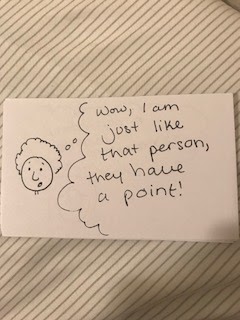
 Part 2:

  • In this part of the paper I will talk about the use of characterization and how it allows the audience to connect with the poem's message. 


 Part 3:

  • In this section of the paper I will explain how the lack of punctuation shows a feeling similar to the stream of thought. This allows readers to connect logically to the piece as they think through the problem in the same manner that the author did.


Part 4

  • I will explain how the use of literary allusions develop the author's logos and why that is important considering that the author is arguing that poetry can change the world.

Saturday, March 24, 2018

Further Thoughts on "'Poetry Makes Nothing Happen'?"


While analyzing the poem "'Poetry Makes Nothing Happen'?" by Julia Alvarez (pictured above), I was amazed to see just how much more of the poem I was able to understand and analyze. I noticed in particular that the author adds her personal opinion in the last couple lines of each stanza. This offers a resolution and purpose to the poetry, reiterating the theme which Alvarez is trying to portray: that poetry indeed does make a difference.

Several different claims can be made about this poem including:

  • Policy: One should look at the poem's allusions, especially in the title, in order to have a full understanding of the theme.
  • Definition: The author's opinion is shown in a couple lines at the end of each stanza. 
  • Comparison: The way in which Alvarez uses punctuation functions like the flow of thought.
  • Evaluation: The characterization within the poem very accurately emphasizes the ties between poetry and humanity.
  • Casual: The use of various authors named in the poem causes the author to gain credibility.

Tuesday, March 20, 2018

Poetry, Poetry, Wherefore Art Thou Poetry?

Source

"Poetry Makes Nothing Happen"?
By: Julia Alvarez

Listening to a poem on the radio,
Mike Holmquist stayed awake on his drive home
from Laramie on Interstate 80,
tapping his hand to the beat of some lines
by Longfellow, while overcome by grief
one lonesome night when the bathroom cabinet
still held her husband's meds, May Quinn reached out
for a book by Yeats instead and fell asleep
cradling "When You Are Old," not the poet's best,
but still ... poetry made nothing happen,

which was good, given what May had in mind.
Writing a paper on a Bishop poem,
Jenny Klein missed her ride but arrived home
to the cancer news in a better frame of mind.
While troops dropped down into Afghanistan
in the living room, Naomi Stella clapped
to the nursery rhyme her father had turned on,
All the king's horses and all the king's men ...
If only poetry had made nothing happen!
If only the president had listened to Auden!

Faith Chaney, Lulu Perez, Sunghee Chen --
there's a list as long as an epic poem
of folks who'll swear a poem has never done
a thing for them ... except ... perhaps adjust
the sunset view one cloudy afternoon,
which made them see themselves or see the world
in a different light -- degrees of change so small
only a poem registers them at all.
That's why they can be trusted, why poems might
still save us from what happens in the world.


Monday, March 19, 2018

Once Upon a Snowy Night


It is a few days from Christmas. Snow drifts lazily down in the cold air as a little girl is hoisted onto her father's shoulders. She is surrounded by softly glowing lights, scattered in the bare trees. A knit hat falls over her eyes and her laughter mingles with that of her father. A white castle rises in the distance, crowned with a golden angel. A sweet melody, drifts throughout the square as if sung by unseen heavenly hosts:

The Spirit of God like a fire is burning!
The latter-day glory begins to come forth;
The visions and blessings of old are returning,
And angels are coming to visit the earth.

We’ll sing and we’ll shout with the armies of heaven,
Hosanna, hosanna to God and the Lamb!
Let glory to them in the highest be given,
Henceforth and forever, Amen and amen!

"The Spirit of God" by William W. Phelps is a beloved hymn within the Church of Jesus Christ of Latter-day Saints (more commonly known as Mormons). It is a song of triumph and joy which looks forward to the Second Coming of Jesus Christ. It is often sung around Christmastime. Every time that I hear or sing this song, I am brought back to that night in temple square. The lyrics to that song have long been one of my favorites, even when I was too young to fully appreciate their meaning. The sweet feeling that accompanies the music always makes me warm, no matter now cold it may be outside. 

Tuesday, March 13, 2018

Pink Floyd Meets Shakespeare

Source
Pink Floyd's David Gilmour has long captivated audiences around the globe with his mesmerizing voice. His music is considered a staple of classic rock, so I was surprised when I saw his adaptation of William Shakespeare's Sonnet 18. Even though I had watched videos of several different poets, I was still the most impressed by this video. His musical rendition of an old poem appeals to new audiences, creating a fresh experience even for those who have read it a number of times. Gilmour seamlessly blends the sonnet's beautiful words to the soft sound of a piano, merging two masterpieces.

The text in and of itself is not a new. It has been recited over and over again for hundreds of years. The vast majority of students have been assigned Sonnet 18 as homework in high school, and have been asked to read and analyze it. There is also an overabundance of movies which allude to this work. The sheer amount of popularity that Shakespeare has leads to its overuse. This can often make the text seem dry and boring -- in dire need of some sprucing up -- something that David Gilmour effectively does.

In the video, there is also a large use of cinematic effect when it comes to lighting and calming images. It was interesting that Gilmour chose to include scenes filmed on a sunny and peaceful river to his adaptation. The song does not require any such images and could have been produced as a stand-alone adaptation. However, the gaiety and innocence of such scenes create a spell-binding tone for a sonnet about admiring a lover, allowing it to be more effectively consumed by the audience.


Sunday, March 11, 2018

Once Upon a Snowy Night (draft)


Picture this. Snow drifts lazily down in the cold air as a little girl is hoisted onto her father's shoulders. She is surrounded by softly glowing lights, scattered in the bare trees. A knit hat falls over her eyes and her laughter mingles with that of her father. A white castle rises in the distance, crowned with a golden angel. A a sweet melody, drifts throughout the square as if sung by heavenly hosts:

The Spirit of God like a fire is burning!
The latter-day glory begins to come forth;
The visions and blessings of old are returning,
And angels are coming to visit the earth.

We’ll sing and we’ll shout with the armies of heaven,
Hosanna, hosanna to God and the Lamb!
Let glory to them in the highest be given,
Henceforth and forever, Amen and amen!

Every time that I hear or sing "The Spirit of God" by William W. Phelps, I am brought back to that night in temple square. The lyrics to that song have long been one of my favorites, even when I was too young to fully appreciate their meaning. The sweet feeling that accompanies the music always makes me warm (no matter now cold it may be outside).

The poetry that makes up this song is best appreciated when critiqued in its historical and religious context. The song was written in response to the building and dedication of the LDS temple in Kirtland, Ohio. A video on the Mormon Channel describes the incident as follows:

"As the blessings of heaven were poured out upon their heads, many of the Saints spoke in tongues, while others were given the power to interpret. Many saw angels atop the temple roof or heard heavenly singing, and there were wonderful manifestations of healings, of visions and dreams. The Savior Himself appeared in five different meetings held in the temple, and visions were given to many of the Father and the Son (source)."

When critiqued through the lens of new historicism, the poem changes meaning. The historical background to this piece makes all the difference in determining its meaning. In the first verse, it discusses visions and blessings of the past returning, alluding to the miraculous occurrences that seemed to be all so common in the Old Testament. The author believed that he was witnessing some of the signs of the last days as he described the angels, visions, and wonderful things that were occurring at this point in time. The audience is able to sympathize with the utter joy that the author must have been feeling at the fact that God was still a God of miracles. How wonderful that the burning bush of Moses' day continues to burn today!

Being a hymn, there is also a significant amount of biblical allusions within the text, which are especially prevalent in the fourth verse which reads: 

How blessed the day when the lamb and the lion
Shall lie down together without any ire,
And Ephraim be crowned with his blessing in Zion,
As Jesus descends with his chariot of fire!

The metaphor of the "lamb and the lion" can be analyzed in two distinct ways. 

  1.   The "lion" described in this verse can be attributed to the house of Judah (a traditional symbol that can be found in Genesis 49:9), while the "lamb" refers to the Savior Jesus Christ. If the symbols are taken in this way, readers can assume that the Jews will accept Christ and his message once the Second Coming occurs.
  2.   The metaphor could be taken in a more literal sense as meaning that there will be no more violence and strife, and that enemies will cease to be and peace will reign as king. A similar metaphor is found in the Bible in the 65th chapter of Isaiah, where it states that the "wolf and the lamb shall feed together... they shall not hurt nor destroy in all my holy mountain".

The word "Zion" is also closely connected with both the Bible and the Second Coming of Jesus Christ. The symbol of Zion changes throughout scripture, first being used to describe the City of David in the Old Testament to just refer to the City of God in the New. However, when taken hand in hand with the historic context, its meaning changes. In Mormonism, Zion is often referred to as more of a mentality, more specifically the "pure in heart" (Doctrine and Covenants 97:21), and the followers of Christ. However, it can also be interchanged with the "New Jerusalem", where the new Holy City will be located.

This song not only inspired the early Latter-day Saints, but continues to do so every day. It has touched my heart many times, from the snowy scene at temple square as a child to the times I have sung it while sitting in a church pew. It is a beautiful literary expression of faith and emotion that all people, religious or not, can appreciate.


Tuesday, March 6, 2018

"The Silent Child" Deserves Loud Acclaim

"The Silent Child" (2017) is a powerful short film written by Rachel Shenton which was featured in the Academy Awards. The movie depicts the life of a four year old deaf child named Libby. This child has been brought up in a "normal" household with a family who does not understand her world and disabilities. Even though the family is a bit ignorant, they hire a tutor to help Libby learn to communicate with those around her. The film beautifully and artfully crafts a narrative in which audiences' hearts are captivated. The film shows two contrasting worlds, one of sound and one of silence. These worlds are placed side by side, and the intense difference is shown through the use of cinematic elements including setting and lighting.
Setting is a large contributor to the dual tones of the film.The hearing world is depicted as closed-off, busy, and confusing. The vast majority of vocal speaking takes place inside of the house or in a cramped car. The room is cluttered with objects, people, voices, and sounds, giving the audience the feeling of being trapped inside of a box with no escape. It is stifling. However, when Libby meets with the tutor, they are often seen learning outside, out in the open sunlight. Physical barriers (such as walls) are destroyed by using wide camera angles and natural sunlight. This fosters a tone of growth, innocence, and openness as the child is not only taught sign language, but is able to finally connect with others. 
There is one particular scene when the two worlds are shown side by side. The scene shows the tutor and Libby laughing out in a bright yard through the windows of the house. Inside of the home is nearly pitch black, and the silhouette of the mother is outlined in the glass. She stands by and watches, alone in the darkness, as her daughter progresses without her. This is a beautiful metaphor in which we see how the mother has isolated herself from her daughter's world, offering a view into her own thoughts.
It was amazing to me how much could be said by saying so little. The producer's decisions to play with lighting and setting told a large part of the narrative. The audience had to pay attention to the visuals, rather than gather all their information from speech. Overall, it was a very soulful and endearing piece fighting to help deaf children.

Saturday, March 3, 2018

A Review of the BYU English Symposium

Brigham Young University students recently gathered for the English Symposium, which highlighted various literary and writing accomplishments found among university students. It was interesting to see students present on meaningful topics and to share their love of the English language. I had the opportunity to attend two of the many sessions which the symposium offered, including the Creative Writing: Undergraduate: Poetry Winners, and Native American Literature.

I greatly enjoyed the listening to the poetry winners. The Hart-Larson Poetry first place winner, Bayley Goldsberry, began with two interesting pieces which discussed the role that Heavenly Mother played in the creation of the world. As she read both "Breath of Life" and "From the Dust", she breathed life into a warm and eternal parent. Goldsberry then went on to share a poem about her father. As the audience listened, the realistic imagery that she used in the poem allowed us to see her father in the same way that she has idolized him in the way only a child can.

Another poet, Rachel Dalrymple, shared a poem of hers as well, although I did not enjoy it quite as well as some of the others. It was obvious that she was a gifted writer, but in my opinion this talent did not translate over to her poetry. Her language was rather technical, invoking a sense of logic rather than emotion. It had very little imagery, and what images she did have (such as describing heels making "a clickety sound") could have been improved upon.

After the poets read their work, they opened up the floor to questions. I enjoyed one particular response where one writer said that poetry is "putting words to something indescribable."

The second session which I attended was interesting, but was in no way as upbeat as the first. All of the authors purpose was clear: that Native American authors are still very relevant. One student, Carly Callister, presented her paper entitled, "Uncovering the Voices that Have Been Silenced: How Cherokee Young Women are Continuing the Traditions of their Ancestors through Literature". In this paper, she outlines how Cherokee women were seen as strong mother figures who raised their voices to be heard. They were an example of leadership among the tribe, even when the Native Americans were forced from their homes and forced to embark on the Trail of Tears. Callister reminded her audience that moral beauty never fades away, and that culture is something that we should be proud of and fight for. Our country still has many people who are bi-racial and bi-cultural, and their words have just as great of a meaning of those without split backgrounds.

Overall, the English Symposium reminded me of why I has decided to become an English major. The love of literature and language is something special and should be revered as such.

Saturday, February 17, 2018

The Taming of the Shrew Did Not Tame Me

I had my first encounter with The Taming of the Shrew this week. I had high hopes as I began to watch the 1967 version, as I have a great appreciation for William Shakespeare. I also realized early on that What I Hate About You is a loose adaptation of this play, containing the same basic story-line, which made me even more excited about the film. However, by the end of the movie I was left severely disappointed.


While The Taming of the Shrew by William Shakespeare is a comedy, it comes across as extremely misogynistic, especially when not done correctly. In the 1967 film adaptation, Petruchio (portrayed by Richard Burton), is portrayed as a witless drunkard, which not only creates a strong dislike for his character, but for the play overall. While I realize that the text in and of itself is aimed at making fun of strong headed women, the actor's character choices detract from what could be a delightful comedy.

In the play, Petruchio seeks to wed Katherine in order to have access to her immense wealth. Throughout the play, he uses various methods and tactics to "tame" his wife and make her fulfill her roles as a woman. Instead of portraying a strong and cunning character attempting to change his wife, Burton comes off as cold-hearted and out of his mind. While the text remains largely true to the original, Burton's crazed laughter as he tortures Katherine through food and sleep deprivation (among other methods), make him appear as a unthinking maniac, intent on hurting his wife. He is often waltzing about the set as though he were drunk and enjoys making a spectacle of himself. Burton's acting creates an extremely off balanced effect in which Shakespeare's classic banter and wittiness that we so love is lost, and the audience is coerced into watching a man physically and verbally abuse his spouse, simply for the pleasure of it. The character falls flat and is unrelatable.

Friday, February 2, 2018

An Elephant Never Forgets


In the short story Hills Like White Elephants, Ernest Hemingway uses intense symbolism within the setting, as well as vague dialogue, in order to engage the reader and clarify the meaning behind the story.

The story takes place at a station in Spain, where a man and a woman are waiting for the next train. They drink as they wait. To one side of the woman sits dry and white hills to which she compares to "white elephants", an innocent enough statement. On the other side lays a green and fertile land, with mountains and a river running through the middle of it. The woman has a choice to make. This setting alludes to the fact that there are two choices before the girl: to go forward into the barren hills to which she compares to the wrinkly skin of "white elephants" or to travel down the fertile and green route. The American man in the story is pressuring the girl into a decision, perhaps an abortion, and the setting is all too fitting, portraying a bleak or a fruitful future for the two depending on the girl's decision. By the end of the story, one might infer that the woman does choose to go along with the abortion (and hop on the train into the white hills) as the couple drinks a few alcoholic drinks -- something one should not do while pregnant.

Hemingway also uses dialogue in a very significant way. Instead of describing the characters directly by using metaphors or other descriptive language, he allows the audience to come to their own conclusions through the characters actions and dialogue. While the couple converses, their words are very vague and not very meaningful in the grand scheme of things. The woman keeps hushing the man, as though she is ashamed to openly discuss the topic. They never directly dwell on the fact that the girl is contemplating to end her pregnancy. It causes the audience to feel as though the "operation" isn't just a trivial matter. It is serious and not openly discussed in public. Unlike the large, white elephant hills, the dialogue's importance is minimized.

Wednesday, January 24, 2018

Colors and Lighting in Hamlet


Color symbolism plays a key role in this scene from Hamlet. There are only a few items of color, including the red of Hamet's uniform and the green and red phones on the right side of the screen. The red of Hamlet's coat could allude to the passion and rage that Hamlet feels as he contemplates suicide. The red and green phones could be placed there to show the contrast of Hamlet's soliloquy and decision whether or not to "stop" his life (red phone), or to "go" on living his life (green phone).

Tuesday, January 23, 2018

Analysis of a Snippet of Hamlet


In this production of Hamlet, there were some specific acting decisions which darkened the tone of the play. During Hamlet's soliloquy, there are moments where the actor alludes to suicide as he either subtly chokes (0:27) or hangs himself (2:42). The decision to include these movements grab the audience's attention and reiterates the drama, despair, and serious nature of the scene.

Tuesday, January 16, 2018

Hailey's Shelfie

My name is Hailey and I am an English teaching major. I have always loved reading and writing and hope to share that love with others. My hair is like my patience for you... short.